
A Psychopath Talking About Seizing Elections—and a Party Too Cowardly to Stop Him
“This isn’t a policy disagreement. It’s authoritarianism, said out loud.”

Short discussion video for paid subscribers follows
What Donald Trump said on Dan Bongino’s show should chill anyone who still believes American democracy is operating on normal rails.
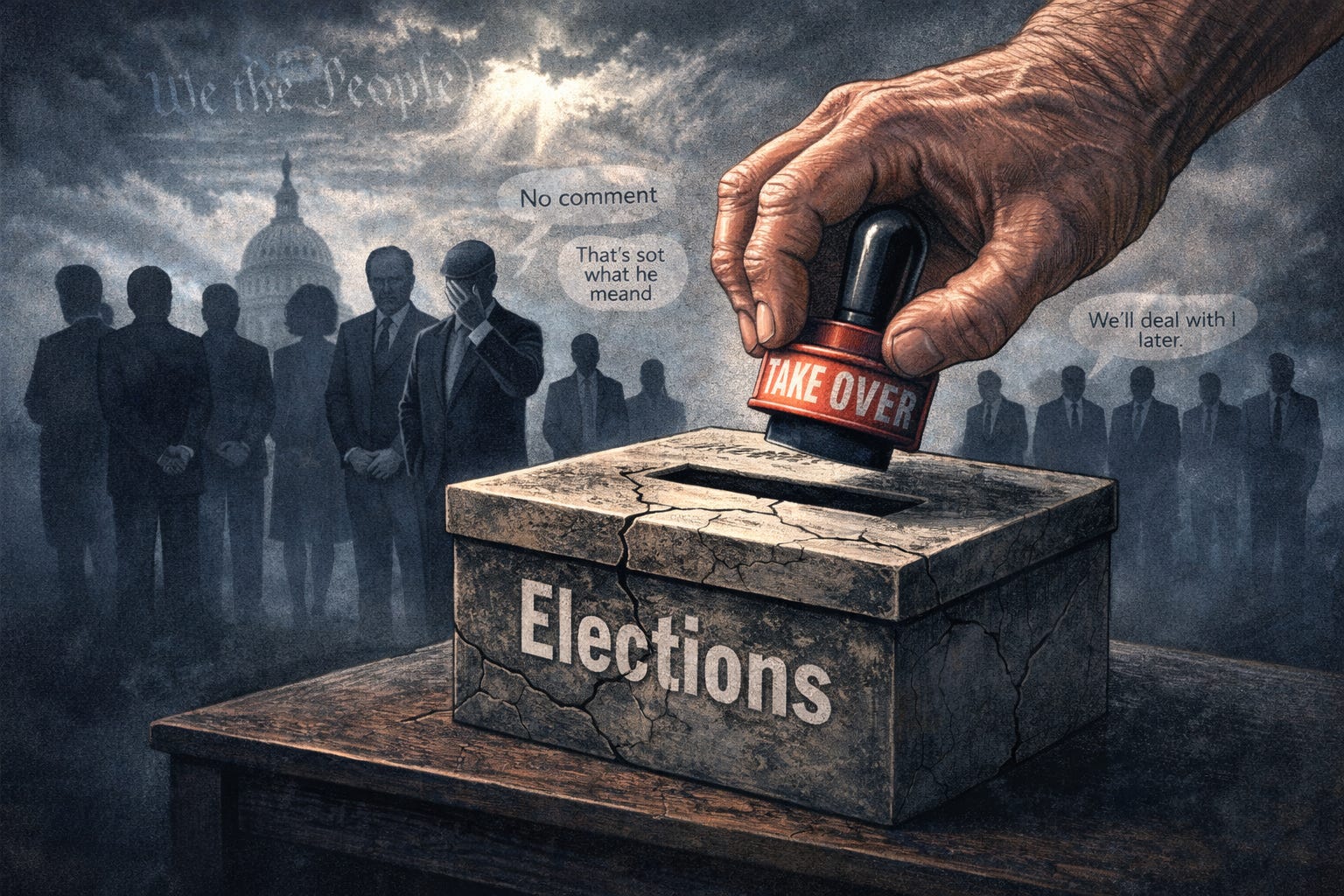
Trump claimed—without evidence—that immigrants were “brought to our country to vote” and that they “vote illegally.” Then he took the next step. He said Republicans should “take over the voting and nationalize it.”
That is not a policy disagreement. That is not rhetorical excess. That is the language of a deranged psychopath who no longer even pretends to accept the most basic premise of a constitutional republic: that elections belong to the people, not to the man who wants to win them.
Let’s be clear about what he’s saying. Trump is arguing that because he believes—again, without evidence—that votes are illegitimate, the federal government should seize control of elections. Not to protect them. Not to administer them fairly. But to “take over” voting itself.
That is authoritarianism, said out loud.
And what makes this moment especially dangerous is not just Trump’s mental unraveling. It’s the silence. The elected Republicans who hear statements like this and either say nothing, shrug, or pretend it’s normal political talk are actively participating in the erosion of democracy.
They know better. Or at least, they should.
There is no factual basis for Trump’s claim. Non-citizens cannot vote in federal elections. There is no evidence of mass illegal voting by immigrants. These lies have been investigated, litigated, audited, and debunked over and over again. Trump knows this. Republican leaders know this. They are lying anyway.
Why? Because the lie serves a purpose.
If Trump convinces his base that elections are inherently fraudulent unless he wins, then any action he takes to “correct” that supposed fraud can be framed as justified. That includes pressuring election officials, intimidating voters, purging rolls, refusing to certify results, or attempting to federalize or “nationalize” elections in ways that strip states and citizens of control.
We have already seen this movie.
In 2020, Trump tried to bully state officials into “finding” votes. He leaned on the Justice Department. He turned the vice president into a target. When all of that failed, he summoned a mob and aimed it at the Capitol. That wasn’t an accident. It was the last step in a process that began with lies about voting.
What he said on Bongino’s show is the next evolution of that same thinking. It’s more explicit now. Less guarded. More unhinged.
And here’s the part Republicans in office cannot escape: their silence is not neutral.
Every time an elected Republican refuses to condemn this rhetoric, they normalize it. Every time they wave it off as “Trump being Trump,” they lower the bar further. Every time they tell themselves they’ll deal with it later, they move the country closer to a moment where dealing with it becomes much harder.
This isn’t just about Trump’s temperament. It’s about intent.
When someone repeatedly claims elections are rigged, then floats ideas about taking control of voting itself, you should assume they are laying the groundwork for interference. Maybe not the same way as last time. Maybe not as chaotically. But with the same goal: ensuring that if the vote doesn’t go his way in November, the system itself can be blamed, overridden, or seized.
That’s why this matters now, not after the election, not after the damage is done.
Republican members of Congress, governors, and party leaders are making a choice in real time. They can say clearly and publicly that elections belong to the states and the voters, that Trump’s claims are false, and that calls to “take over” voting are unacceptable in a democracy.
Or they can stay quiet, look away, and hope they personally survive the fallout.
History will not be kind to the second group.
Because authoritarian movements don’t succeed only because of the strongman at the center. They succeed because of the enablers—the people who knew it was wrong but decided that speaking up was inconvenient, risky, or bad for their careers.
Trump’s statement wasn’t a slip. It was a window into how he thinks. Elections are obstacles. Votes are negotiable. Power is personal.
That mindset is profoundly dangerous.
The good news—because there is still good news—is that the system has held before. Courts have held. State officials have held. Voters have held. But those guardrails only work if people defend them openly and early, not quietly and late.
Calling this out is not “anti-Republican.” It is pro-democracy. It is not partisan to say that a president or candidate who talks about nationalizing voting is unfit to be trusted with power.
The real question now is simple: how many elected Republicans are willing to say that out loud?
Because if they don’t, they won’t be able to claim surprise when Trump tries something in November. They will have helped pave the road.
Democracy doesn’t usually die in one dramatic moment. It erodes under the weight of lies, cowardice, and silence.
We are watching that erosion happen in real time.
Short discussion video for paid members:
